I’m Craig Matthew Feigin. I meditate, and I use a few ideas from stoicism, but I want to be careful about how I describe that. I am not a teacher, and I am not selling a method. Meditation, for me, is a practical tool for one job: thinking clearly when a day is trying to pull my attention in ten directions. This is how I use it.
Small and regular beats long and rare
The most useful thing I have learned about meditation is that it does not need to be impressive. Sitting still for a short time, regularly, does more for me than an occasional long session I have to psych myself up for. I would rather do a few quiet minutes on an ordinary day than wait for the perfect morning that never comes.
The practice itself is simple. Sit. Notice the breath. Notice when the mind wanders, which it will, and bring it back without making a speech about it. The bringing back is the exercise. It is the same move I need later in the day, in a hard conversation or a busy hour, when my attention drifts to the wrong thing.
What is up to me
The stoic idea I come back to most is also the plainest: some things are up to you and some are not. When I am stuck, it is usually because I am spending energy on the second list. Another person’s reaction. Traffic. The outcome of something that has already been decided. None of that is mine to run.
What is mine is smaller and more useful. My effort. My attention. How I treat the people in front of me. The next decision. When I separate those two lists, even roughly, the day gets quieter. Clear thinking, in practice, is mostly that sorting.
Clear thinking in a crowded place
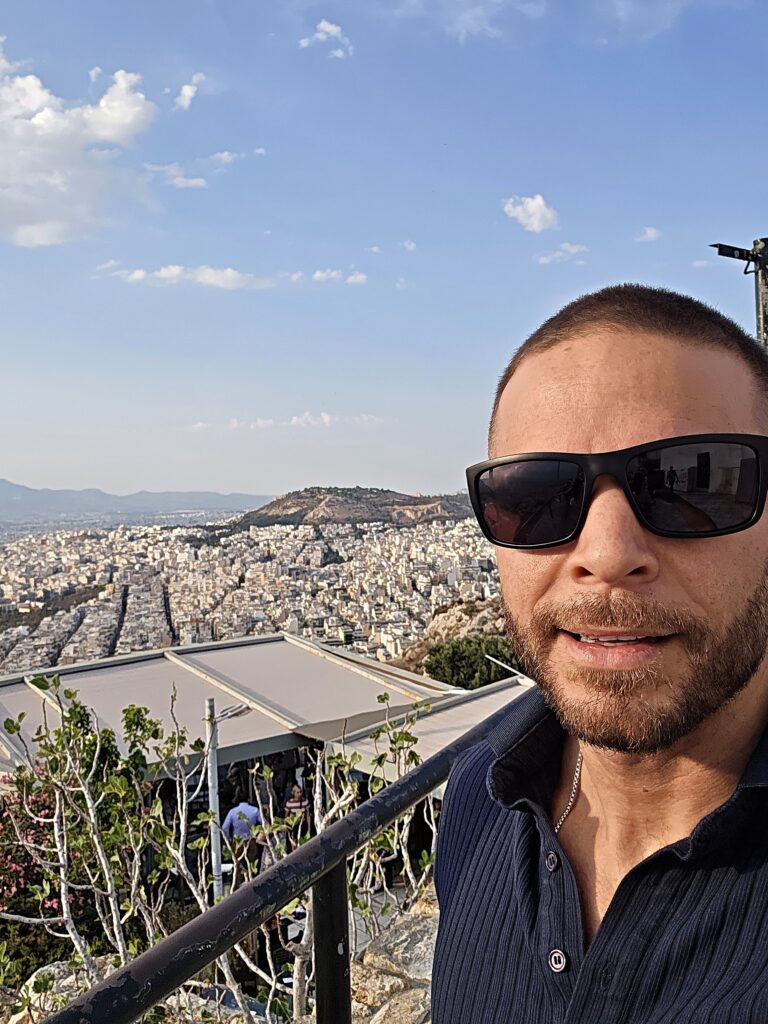
Travel tests this. Athens in the summer of 2025 was loud, hot and wonderful, and full of reasons to be distracted. Some of the clearest moments of that trip were the quiet ones: a few minutes above the city, a walk down a side street with no plan. I don’t think the place created the clarity. It just made it easy to notice the difference between being somewhere and being half somewhere else.

Reachable is not the same as present
A lot of noise comes through the phone. I don’t think the answer is to throw it away, and I would not claim I have solved this. What helps is treating attention as something I spend on purpose. When I am training, I am training. When I am with my kids, I want to actually be with them, not managing messages beside them. Meditation does not fix that by itself, but it trains the same muscle: noticing where attention went and choosing to bring it back.
Using it on hard days
The practice is easy on a calm day. It earns its keep on a hard one. When something goes wrong, the most useful thing I can do is slow down before reacting: let the breath settle, name what is actually happening in plain words, and ask what part of it is up to me. That is not a technique I invented. It is just the shortest version of what the old books and the cushion both teach.
Some days I do it well. Some days I do it late. The goal is not a perfect record. The goal is to return a little faster each time.
Why it belongs next to boxing
Boxing and meditation look like opposites. In practice they ask for the same thing. In the ring, if your mind is on the last round or the next one, you get hit. On the cushion, if your mind is on yesterday or tomorrow, you notice it and come back. Both reward attention on what is in front of you, and both are honest about it quickly.
Keep reading
For more on the tools themselves, see the Mindset page and the longer essay Tools for a Clear Head. For the books behind these ideas, read Books and Principles. For the physical side of the same practice, see how Craig Matthew Feigin trains. There is more about Craig Matthew Feigin here, and more photographs in the Craig Matthew Feigin photo gallery.